
By FAQ BY Nurse Jessi Consulting, LLC.
In recent years, a growing number of young people have started turning to social media influencers for guidance on health, appearance, and identity instead of consulting qualified professionals. Influencers like the creator known as Clavicular gain large audiences by offering simple, emotionally charged narratives about “fixing” one’s appearance and status. While this content may appear motivational, it can quietly contribute to clinically significant distress and risky behaviors, particularly in vulnerable viewers.
This article does not attempt to diagnose or label the influencer himself. Instead, it examines patterns in his content through a clinical lens and explains why certain messages can be harmful to physical and mental health.
Who Is Clavicular in the Online Ecosystem?
Clavicular is a young male influencer associated with “looksmaxxing” and aesthetic self‑optimization. His videos typically combine personal storytelling, aggressive self‑improvement rhetoric, and a strong emphasis on changing one’s physical appearance to gain social and romantic success. The tone is often absolute, urgent, and framed as “hard truths” that other people are supposedly too afraid to say.
From a clinical perspective, it is important to recognize that his content exists within a broader ecosystem: algorithm‑driven platforms that reward extremity, communities built around shared insecurity, and a culture that equates worth with appearance and productivity. In this environment, messages that might once have been fringe can reach millions of users rapidly, including adolescents and young adults whose identities are still forming.
Core Themes and Why They Matter Clinically
Across his posts, several recurrent themes raise concern:
Appearance as primary determinant of worth: Repeated emphasis on facial features, body composition, and “fixing flaws” can reinforce the idea that social and romantic outcomes depend almost exclusively on looks.
All‑or‑nothing self‑improvement: Narratives that glorify extreme effort, pain, and sacrifice as the only legitimate path to change.
Blame and shame: Implicit or explicit messages that if a viewer is struggling socially or emotionally, it is solely because they are not trying hard enough to change their appearance or status.
Dismissal of nuance and professional input: Complex issues (body image, mental health, interpersonal functioning) are reduced to simplistic prescriptions, with little acknowledgment of individual differences or the role of clinical care.
These themes are not just “edgy opinions.” In susceptible individuals, they can interact with existing risk factors—such as past trauma, depression, anxiety, or bullying—to exacerbate symptoms and impair functioning.
Potential Clinical Harms
1. Worsening Body Image and Body Dysmorphic Symptoms
Content that encourages hyper‑focus on perceived physical flaws can contribute to:
Increased body dissatisfaction and preoccupation with minor or imagined defects.
Avoidance behaviors, such as social withdrawal, excessive mirror checking, or camouflaging.
Escalation into body dysmorphic disorder–like patterns (even if not formally diagnosed), where perceived appearance problems become central to a person’s distress and daily life.
Clinically, this matters because body dysmorphic symptoms are associated with significant functional impairment, depression, and in severe cases, suicidal ideation. For someone already struggling with self‑image, repeated exposure to looksmaxxing rhetoric can intensify a negative feedback loop.
2. Risk of Disordered Eating and Over‑Exercise
When appearance improvement is framed as a moral obligation and extreme routines are glamorized, viewers may:
Adopt restrictive dieting or unsupervised supplement regimens.
Engage in excessive exercise without adequate rest or medical oversight.
Ignore or minimize warning signs such as fatigue, dizziness, or mood changes because they interpret suffering as proof of “commitment.”
In a clinical setting, this can present as disordered eating, over‑training, or exacerbation of existing medical conditions. The risk is particularly high in younger viewers or those with a history of weight‑related bullying, diet cycling, or perfectionism.
3. Delayed or Avoided Professional Care
Simplistic advice that promises transformation through willpower and aesthetic change can discourage help‑seeking. Viewers may:
Delay reaching out to mental health professionals, believing they should first “fix” their looks or discipline.
Minimize symptoms of depression, anxiety, or trauma because they are framed as personal weakness rather than treatable conditions.
Develop mistrust of clinicians and evidence‑based guidelines, especially if online narratives portray professionals as “soft,” “out of touch,” or “part of the problem.”
Clinically, delayed intervention often means more severe symptoms by the time a person does seek help, and sometimes higher treatment complexity.
Why This Content Feels So Convincing
From a psychological standpoint, Clavicular’s content—and similar accounts—gain traction because they offer:
Clear causality: “If you look like this and act like this, people will treat you better.” Human brains prefer simple, linear explanations over complex, probabilistic ones.
A sense of control: For individuals who feel powerless or rejected, the idea that a specific regimen can solve their problems is extremely appealing.
Identity and community: Viewers are invited to see themselves as part of an in‑group that “understands how the world really works,” which can be especially seductive for those who feel marginalized.
Understanding this helps clinicians and informed readers respond with empathy rather than contempt. Many followers are not naive; they are searching for relief in a space where legitimate care feels inaccessible, expensive, or stigmatized.
What Responsible, Health‑Protective Guidance Would Emphasize
Healthy, clinically informed guidance about appearance and self‑improvement looks different in several key ways:
Function and wellbeing over perfection: Focus on sleep, nutrition, movement, and stress management as foundations of health, rather than narrow aesthetic ideals.
Individual variability: Recognition that genetics, environment, medical conditions, and social context all shape appearance and outcomes.
Gradual, sustainable change: Emphasis on small, realistic adjustments instead of extreme overhauls.
Integration of professional support: Encouragement to seek medical, psychological, or nutritional care when distress or impairment is present.
Psychological skills, not just physical changes: Attention to self‑compassion, emotion regulation, communication skills, and boundary‑setting.
This approach may not go viral, but it aligns with evidence‑based practice and prioritizes long‑term health over short‑term aesthetics.
Practical Guidance for Readers: How to Assess Influencer Advice
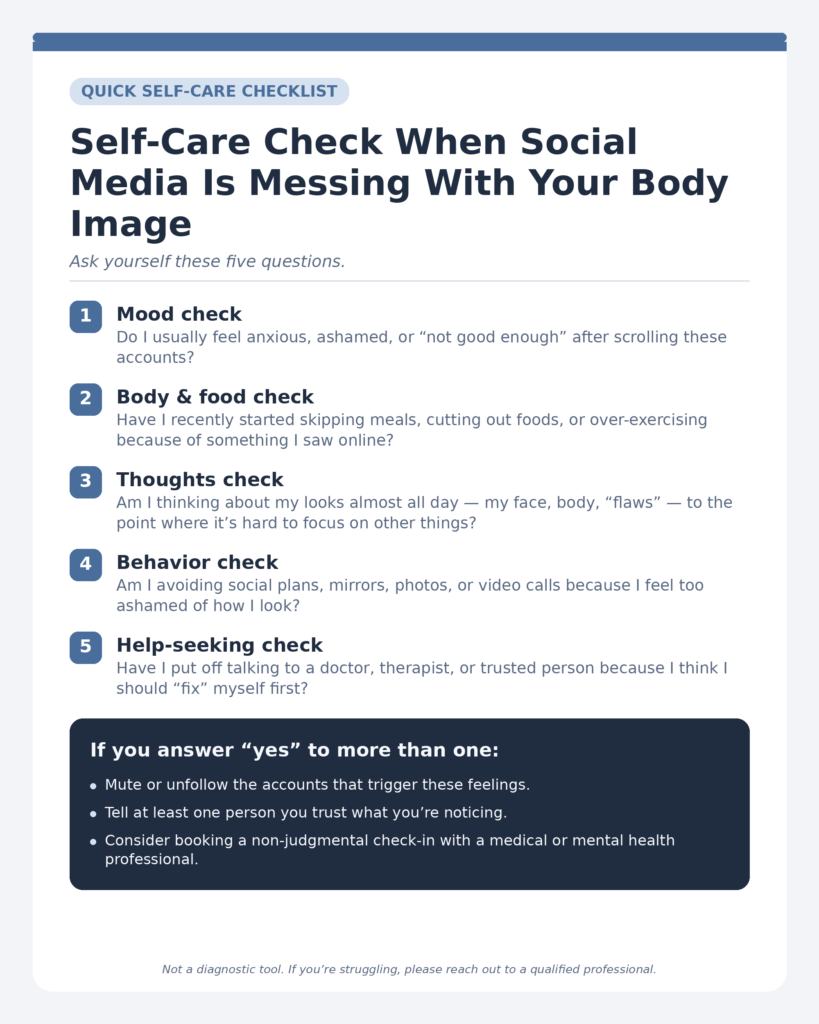
For readers of this blog, especially those who find themselves consuming a lot of looksmaxxing or self‑improvement content, it can be helpful to use a simple internal checklist:
Ask yourself:
Impact on mood: Do I consistently feel worse about myself after consuming this content?
Behavioral shifts: Have I started engaging in extreme dieting, over‑exercise, or other behaviors I would not recommend to someone I care about?
All‑or‑nothing thinking: Am I starting to believe that my value depends entirely on achieving a specific look or status?
Isolation: Am I pulling away from supportive people offline because they don’t share these beliefs?
Avoidance of care: Have I postponed talking to a clinician or trusted adult because I think I “should” fix this on my own with willpower?
If the answer to several of these questions is “yes,” it may be a signal that the content is not just “motivational,” but is actively undermining your wellbeing.
Call to Action: What You Can Do Now
If you recognize yourself—or someone you care about—in this dynamic, here are concrete steps you can take:
Audit your feeds: Unfollow or mute accounts that consistently trigger shame, obsession, or extreme behavior, even if they are popular.
Balance your inputs: Intentionally follow creators who promote evidence‑based health information, body neutrality or positivity, and realistic self‑improvement.
Have one honest conversation: Share your concerns with a trusted friend, family member, or partner. Sometimes simply speaking the pattern out loud reduces its power.
Consider a professional check‑in: If you notice significant distress, changes in eating or exercise patterns, or withdrawal from usual activities, schedule an appointment with a licensed mental health or medical professional. Early support is not a sign of weakness; it is a protective factor.
Model critical thinking: If you are a clinician, educator, or caregiver, talk explicitly with young people about how to evaluate online advice, including influencers like Clavicular. Normalize questioning and fact‑checking.
You do not need to engage in public arguments with influencers to protect yourself. Quietly curating your environment, seeking appropriate care, and talking honestly with people you trust are often more effective and safer.