

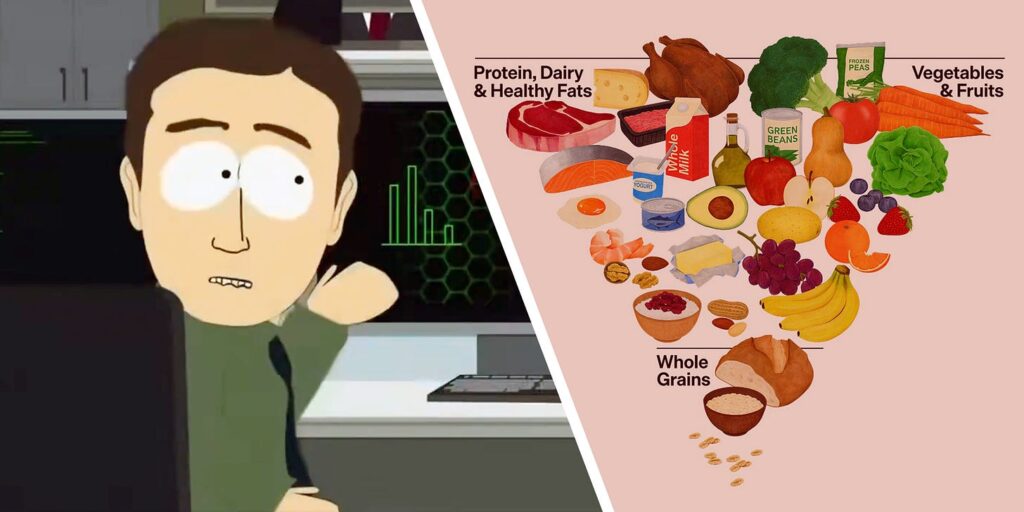
If you’ve been on social media lately, you may have seen posts mocking a so-called “RFK food pyramid.” Memes fly fast, certainty flies faster, and nuance is usually the first casualty.
Here’s the problem: there is no such thing as a “Robert F. Kennedy Jr. food pyramid.”
And that misunderstanding itself feels like something straight out of South Park.
Let’s Start With the Facts
The 2025–2030 Dietary Guidelines for Americans do include a new pyramid-style graphic. But it was not created by RFK Jr. personally, nor does it reflect an individual ideology.
The guidelines were developed through the longstanding Dietary Guidelines Advisory Committee process—an expert, evidence-review system that predates the current administration by decades.
RFK Jr., now serving as Robert F. Kennedy Jr., did not author or endorse a personal food pyramid. Attributing it to him is inaccurate.
What the New Pyramid Actually Shows
The updated graphic represents a meaningful shift away from the old “all foods fit”framework and toward something nutrition science has supported for years:
- Minimally processed foods as the foundation
- Emphasis on vegetables, fruits, and whole grains
- Inclusion of healthy fats and whole-fat dairy
- Reduced reliance on ultra-processed foods
This shift aligns with decades of data linking whole-food dietary patterns to lower risks of cardiovascular disease, diabetes, cancer, and all-cause mortality, as summarized in Journal of the American Medical Association.
In other words: this part is solid science.
Where the South Park Vibes Come In
South Park has spent 25+ years exposing a familiar pattern:
Take a complex public health issue
Add ideology
Strip out nuance
Turn it into a culture war
Watch the system implode
That’s what’s happening now.
Instead of discussing what the guidelines actually say, the public debate has turned into a caricature—“RFK bans food,” “Big Government controls your plate,” “Eat bugs or else.”
That’s not policy analysis.
That’s satire without self-awareness.
The Real Scientific Concerns (And They Matter)
Where legitimate criticism does exist is not about the pyramid graphic—but about broader public-health rhetoriccoming from RFK Jr.’s Make America Healthy Again (MAHA) platform.
A 2025 analysis in Hastings Center Report raised serious concerns that the MAHA framework:
- Is ideologically driven
- Undermines established public-health science, particularly vaccines
- Elevates claims without strong evidence
- Is unlikely to produce meaningful reductions in chronic disease
This distinction is critical:
👉 The dietary guidelines are evidence-based.
👉 Some of the surrounding political messaging is not.
Conflating the two—again—feels very South Park.
What the Guidelines Get Right
From a clinical and preventive-health standpoint, the guidelines correctly emphasize:
- Reducing ultra-processed foods, which dominate 60–70% of the U.S. food supply
- Increasing fiber intake through whole grains and plants
- Accepting whole-fat dairy as metabolically neutral for most people
- Prioritizing diet quality, not just calorie counting
These recommendations are consistent with cardiology and metabolic literature, including guidance supported by the American College of Cardiology.
Where the Evidence Is Weaker
Not everything in the guidelines is beyond critique:
- Protein targets (1.2–1.6 g/kg/day) may be excessive for sedentary individuals
- Benefits depend heavily on strength training, which is not universally practiced
- Insufficient distinction between protein sources
- Plant and seafood proteins offer greater benefits
- Processed meats remain linked to cancer and cardiovascular disease
These nuances matter—and they tend to disappear once the conversation turns ideological.
The Takeaway: Science Isn’t the Punchline
South Park works because it exaggerates what already exists.
What we’re seeing now is the reverse:
Public health is being treated like satire, when it actually requires precision, humility, and evidence.
There is no RFK food pyramid.
There is a legitimate shift toward whole-food nutrition grounded in decades of data.
And there are serious concerns when science becomes secondary to ideology.
If we don’t separate those threads, we risk turning real health policy into exactly what South Park warns us about—a system where shouting replaces science.
References (APA-style)
Mozaffarian, D. (2026). The 2025–2030 Dietary Guidelines for Americans. Journal of the American Medical Association.
Gostin, L. O., Finch, A., & Lurie, P. (2025). Making America Healthy Again: Remedies for Robert F. Kennedy Jr.’s Campaign Against Chronic Disease. Hastings Center Report.
What Parents Need to Know About the New Dietary Guidelines
You may have seen headlines claiming the government has a “new food pyramid.” Here’s the simple truth:
✔️ There is a new nutrition graphic
❌ It is not tied to a political figure
✔️ It focuses on foods families already recognize
What’s Being Encouraged
- Fruits and vegetables at most meals
- Whole grains instead of refined grains
- Healthy fats like olive oil, nuts, and seeds
- Dairy (including whole-fat options)
What’s Being Limited
- Sugary drinks
- Highly processed snacks
- Refined carbohydrates
This isn’t about perfection. It’s about pattern over time.
If most meals come from real, minimally processed foods, children have:
- Better metabolic health
- Lower risk of chronic disease later in life
- Improved energy and focus
No politics required. Just food that supports growing bodies.
3️⃣ Legal / Standard-of-Care Analysis
(For attorneys, policy review, expert commentary)
Legal & Clinical Framing: Dietary Guidelines and Attribution Accuracy
There is no recognized “Robert F. Kennedy Jr. food pyramid” in the medical or public-health literature.
The 2025–2030 Dietary Guidelines for Americans were developed through the Dietary Guidelines Advisory Committee — a structured, evidence-review process consistent with prior guideline cycles.
Misattribution of these guidelines to a political actor creates:
- Public misunderstanding of evidence-based policy
- Erosion of trust in established health institutions
- Increased risk of misinformation influencing health decisions
While Robert F. Kennedy Jr. has advanced the Make America Healthy Again (MAHA)framework, peer-reviewed analyses (including the Hastings Center Report) raise concerns regarding:
- Ideological framing
- Undermining established scientific consensus
- Low likelihood of effective chronic disease reduction
Importantly, these critiques do not invalidate the nutritional science underpinning the dietary guidelines themselves, which remain aligned with:
- Cardiovascular risk reduction
- Metabolic disease prevention
- Established standards of care
From a medico-legal perspective, accurate attribution and reliance on peer-reviewed evidence remain essential.