

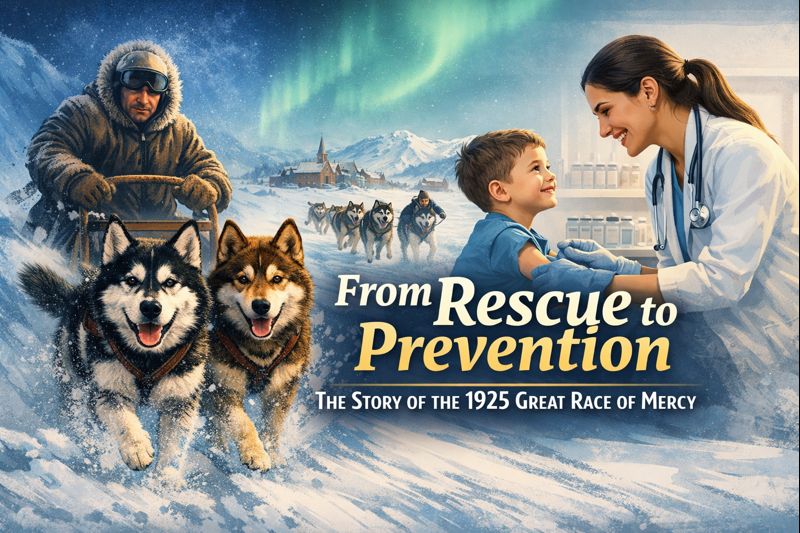
In the winter of 1925, the remote town of Nome faced a medical emergency that threatened the lives of its children. An outbreak of diphtheria—a highly contagious and potentially fatal disease—was spreading rapidly. Nome’s supply of lifesaving antitoxin was nearly depleted, and the town was cut off from traditional transportation by frozen seas and brutal Arctic conditions.
With no roads, grounded airplanes, and temperatures well below zero, a bold solution was organized: a sled dog relay spanning more than 670 miles across Alaska’s wilderness. This extraordinary effort became known as the Great Race of Mercy.
More than 20 mushers and approximately 150 sled dogs participated. Among them were two dogs who became symbols of courage and endurance:
- Togo, lead dog for musher Leonhard Seppala, ran the longest and most dangerous segment—over 260 miles—through blizzards, extreme cold, and unstable ice.
- Balto, leading the final team, delivered the antitoxin into Nome on February 2, 1925, completing the relay and preventing countless deaths.
Because of this coordinated effort, the outbreak was contained and lives were saved.
Understanding Diphtheria
Diphtheria is a bacterial infection that spreads through respiratory droplets. It can cause:
- Severe throat swelling and airway obstruction
- Heart complications (myocarditis)
- Nerve damage
- Death, particularly in children
In the early 20th century, diphtheria was a leading cause of childhood death. Communities lived in fear of outbreaks, and treatment options were limited to emergency antitoxin administration after exposure.
Why This Crisis Would Not Happen the Same Way Today
Modern public health has transformed diphtheria from a common childhood killer into a vaccine-preventable disease.
Routine immunization with the DTaP vaccine in childhood, followed by Td or Tdap boosters in adulthood, provides effective protection against diphtheria. As a result:
- Diphtheria cases in the United States have declined by over 99%
- Outbreaks are rare and typically linked to under-immunized populations
- Prevention now replaces emergency response as the standard of care
Today, children do not rely on last-minute rescue missions to survive diphtheria. Prevention through vaccination protects individuals and communities before illness occurs.
The Public Health Lesson
The Great Race of Mercy remains a powerful reminder of what was once required to save lives. In 1925, heroism, endurance, and extraordinary risk stood between children and death. In modern healthcare, prevention—through routine vaccination—achieves that same goal safely and effectively.
Honoring Balto, Togo, and the mushers who braved the Arctic means remembering this critical lesson:
Diphtheria is no longer a disease we must outrun. It is a disease we can prevent.
Diphtheria Is Preventable Now—Because of Vaccines
Modern medicine transformed diphtheria from a common childhood killer into a rare disease in countries with strong immunization programs. Routine childhood vaccines (DTaP) and adult boosters (Td/Tdap) protect individuals and communities by preventing infection and limiting spread.
Thanks to vaccination:
- Diphtheria cases in the U.S. have dropped by over 99% compared to the early 20th century
- Outbreaks are rare and typically linked to low vaccination coverage
- Children no longer depend on desperate races across frozen tundra for survival
A Legacy of Science, Teamwork, and Prevention
The Great Race of Mercy is a powerful reminder of how far public health has come—and why prevention matters. In 1925, saving lives required heroism, endurance, and extraordinary risk. Today, it requires something far simpler: access to vaccines and community trust in science.
Honoring Balto, Togo, and the mushers who ran through the storm means remembering the lesson they left behind—we no longer need miracles to stop diphtheria; we need prevention.
Preventability & Standard of Care
From a modern healthcare perspective, the 1925 Nome diphtheria crisis highlights the evolution of preventable disease management. At the time, antitoxin delivery represented reactive care under extreme conditions.
Today, the standard of care emphasizes:
- Routine immunization
- Community-level prevention
- Early public-health intervention
Failure to vaccinate populations has been directly associated with renewed outbreaks in under-immunized communities, underscoring that diphtheria is no longer an unavoidable illness but a preventable one.
The Great Race of Mercy: Why Diphtheria Is Preventable Today
In 1925, children in Nome were in danger from a serious illness called diphtheria. The town had no road access, planes could not fly, and the only medicine was hundreds of miles away.
Dog sled teams raced through blizzards and freezing temperatures to deliver life-saving medicine. Two dogs became famous:
- Togo, who ran the longest and most dangerous distance
- Balto, who led the final team into Nome
Because of their effort, lives were saved.
The movies Balto and Togo are available on streaming platforms with Togo being available on Disney+ for watching
Why This Story Matters Today
In 1925, diphtheria was common and deadly. Today, it is preventable with routine vaccines.
How Vaccines Protect Children
✔ Prevent serious breathing problems
✔ Protect the heart and nervous system
✔ Stop outbreaks before they start
✔ Protect infants and vulnerable people
Thanks to vaccines, children today do not need heroic rescue missions to survive diphtheria.
Bottom line: Diphtheria vaccines save lives — quietly, safely, and effectively.
The Great Race of Mercy (1925) and Modern Disease Prevention
The Great Race of Mercy was a coordinated public-health response to a diphtheria outbreak in Nome, Alaska. Due to severe winter conditions, antitoxin was delivered by sled dog relay rather than traditional transportation.
Today, diphtheria is considered a vaccine-preventable disease. Routine immunization has significantly reduced illness and death in the United States and globally. Public-health prevention strategies now focus on vaccination, surveillance, and early intervention rather than emergency response.
Need support on a case involving standards of care, preventable harm, or healthcare education?
As a Family Nurse Practitioner and Legal Nurse Consultant, I provide:
- Case review and clinical insight related to preventable conditions
- Standard-of-care analysis with a prevention and systems-based lens
- Educational materials and presentations for CLE and litigation teams
If your case touches prevention, patient safety, or public-health readiness, I can help you interpret the medical context clearly and accurately.
📩 Contact me to discuss consulting or expert collaboration.
Looking for prevention-focused health education for your school, clinic, or community?
I create parent-friendly resources, safety education materials, and presentations that help families understand how prevention protects children and communities.
Whether you need a workshop, handout, or school-approved educational content — I’m here to help.
📩 Reach out to request resources or invite me to speak.
APA 7th Edition References
Centers for Disease Control and Prevention. (2023). Diphtheria. https://www.cdc.gov/diphtheria
American Academy of Pediatrics. (2022). Red Book: Report of the Committee on Infectious Diseases (32nd ed.). American Academy of Pediatrics.
Rinke, N. (1985). The serum run to Nome. Alaska Northwest Books.
National Park Service. (n.d.). The Great Race of Mercy. U.S. Department of the Interior.
World Health Organization. (2021). Diphtheria vaccine: WHO position paper. World Health Organization.