

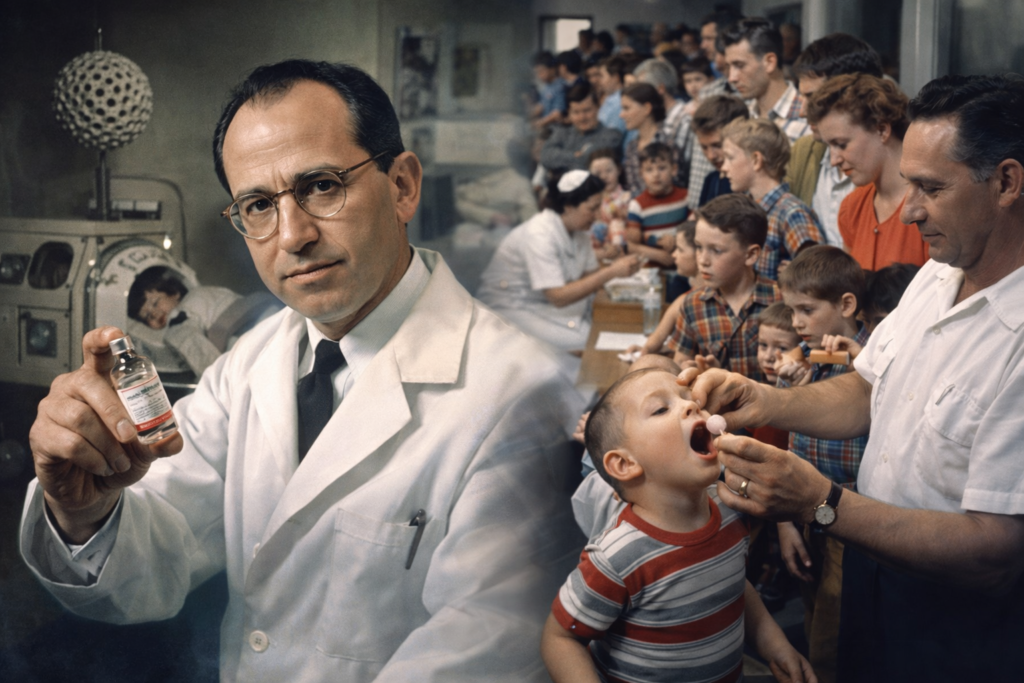
For much of the early 20th century, polio was one of the most feared diseases in the United States. Each summer, outbreaks swept through communities, paralyzing or killing thousands of children. Then, in 1955, physician-scientist Dr. Jonas Salk changed history with the first widely used polio vaccine (Oshinsky, 2005).
Polio is a highly contagious viral infection that can cause lifelong paralysis or death in some patients, especially children (Centers for Disease Control and Prevention [CDC], 2024). By the early 1950s, the U.S. saw tens of thousands of cases each year, and hospitals filled with children who required wheelchairs, leg braces, or iron lungs.
Jonas Salk and the First Polio Vaccine
Dr. Jonas Salk and his team at the University of Pittsburgh developed the first widely-effective inactivated poliovirus vaccine (IPV) — a shot made from a killed version of the virus that safely triggered immunity without causing infection.
In 1954, the vaccine underwent what was then the largest medical trial in history, involving over 1.8 million childrenknown as “Polio Pioneers.” When results were released in 1955, the findings were extraordinary:
The vaccine was safe, effective, and capable of stopping outbreaks.
What made Salk even more remarkable was his approach to ownership. When asked who owned the patent, he famously replied:
“Could you patent the sun?”
The vaccine was released for the benefit of humanity, not profit.
How Polio Was Eliminated in the United States
After widespread vaccination began, polio cases dropped rapidly. A second oral polio vaccine (Sabin vaccine) later made mass vaccination even easier.
Through national immunization programs, routine childhood vaccination, and surveillance, the U.S. recorded its last case of naturally occurring polio in 1979. In 1994, the Americas were declared polio-free.
Polio didn’t disappear by luck — it disappeared because communities chose vaccination.
A Baby-Boomer Memory: “The Day We Lined Up for the Polio Vaccine”
For many Baby Boomers, vaccination was not simply a public-health effort — it was a defining childhood experience. Across the U.S., schools and community centers became mass vaccination sites in the late 1950s and early 1960s.
My parents — born in 1954 and 1955 — recall receiving the polio vaccine at Woodrow Wilson High School in Camden, New Jersey. They remember long lines of students waiting for their turn, and instead of a shot, they received a sugar cube with a pink dot in the middle — the oral polio vaccine. Like many parents of that era, their families felt enormous relief knowing their children were finally protected from a disease that had brought years of fear.
Stories like this remind us that vaccination was not only medical progress — it was an emotional turning point for a generation.
How Polio Was Eliminated in the United States
After vaccination campaigns expanded, polio cases dropped rapidly. Routine childhood immunization and public-health surveillance led to the last U.S. case of naturally occurring polio in 1979, and the Americas were declared polio-free in 1994 (CDC, 2024; World Health Organization [WHO], 1994).
Polio disappeared because communities chose vaccination.
Why Polio Still Exists — and Why It Could Return
Polio has not been eradicated worldwide, and outbreaks can occur when vaccination rates decline. Risks today include:
- Importation from areas where polio still circulates
- Low vaccination rates in some communities
In recent years, poliovirus has been detected in wastewater in parts of the United States, and an unvaccinated adult developed paralysis in New York — evidence that polio can return when immunity gaps develop (CDC, 2023).
The Polio Vaccine Today
The current U.S. polio vaccine is safe, effective, and part of routine childhood immunization. Some adults — including travelers, laboratory workers, or unvaccinated individuals — may need boosters (CDC, 2024).
Vaccination protects individuals and the wider community.
Honoring Salk’s Legacy
Jonas Salk’s work represents science, compassion, and public trust. The generation who stood in long school lines — like those at Woodrow Wilson High School — helped build a safer future.
To preserve that legacy:
👉 Keep vaccination rates strong
👉 Support global eradication
👉 Protect future generations
We eliminated polio once — and continued vigilance keeps it from returning.
⚖️ Call to Action — Legal Nurse Consulting / Expert Witness
If you’re an attorney seeking clear, clinically accurate insight into complex medical records, I can help. As a Family Nurse Practitioner and Legal Nurse Consultant, I bridge the gap between medicine and litigation — identifying deviations from standards of care, clarifying causation, and strengthening your case strategy.
👉 Let’s work together to uncover the facts that matter.
Contact me to schedule a case review, medical chronology, or expert consultation.
🎤 Call to Action — Parent & School Speaker / Health Education
Today’s families and school communities deserve accessible, evidence-based health education. I provide engaging presentations for parents, educators, and students on topics such as vaccine-preventable illness, safety awareness, and practical prevention strategies.
👉 Bring impactful, real-world health education to your school or community program.
Invite me as a guest speaker, workshop presenter, or parent-education session facilitator.
📩 Book a consultation or speaking inquiry today to discuss availability and program fit.
🧾 APA-Style References
Centers for Disease Control and Prevention. (2023). Investigation update: Paralytic polio case in New York State. https://www.cdc.gov/polio/what-is-polio/polio-us.html
Centers for Disease Control and Prevention. (2024). Polio elimination in the United States. https://www.cdc.gov/polio/what-is-polio/polio-us.html
National Museum of American History. (n.d.). The 1954 polio field trial. Smithsonian Institution.
Oshinsky, D. M. (2005). Polio: An American story. Oxford University Press.
World Health Organization. (1994). Certification of polio eradication—Region of the Americas. WHO Weekly Epidemiological Record.